The first endorsement of Toronto Mayoral candidate Chris Alexander raised more than a few eyebrows, with commentators suggesting the content was generated by artificial intelligence.
Alexander made several social media posts during the week of August 10th that drew quotes from an article endorsing Alexander written by columnist Clinton Desveaux, and published August 9th 2026 on the commentary website Unpublished.
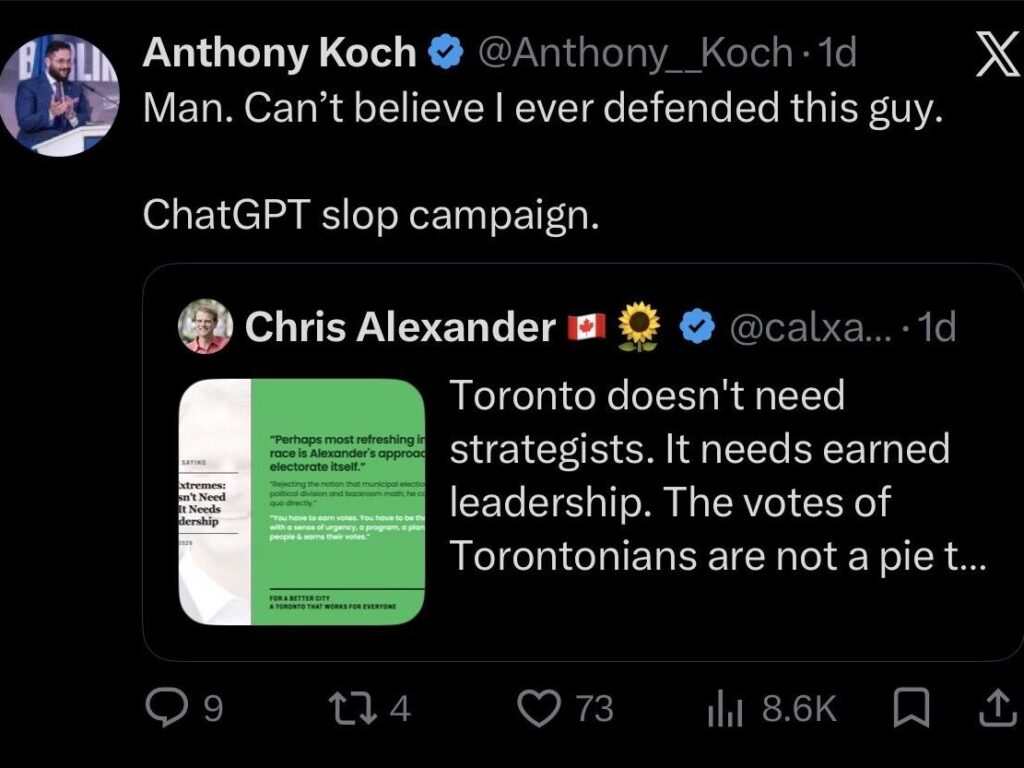
The article is titled “Beyond The Extremes: Toronto Doesn’t Need Strategists, It Needs Earned Leadership.”
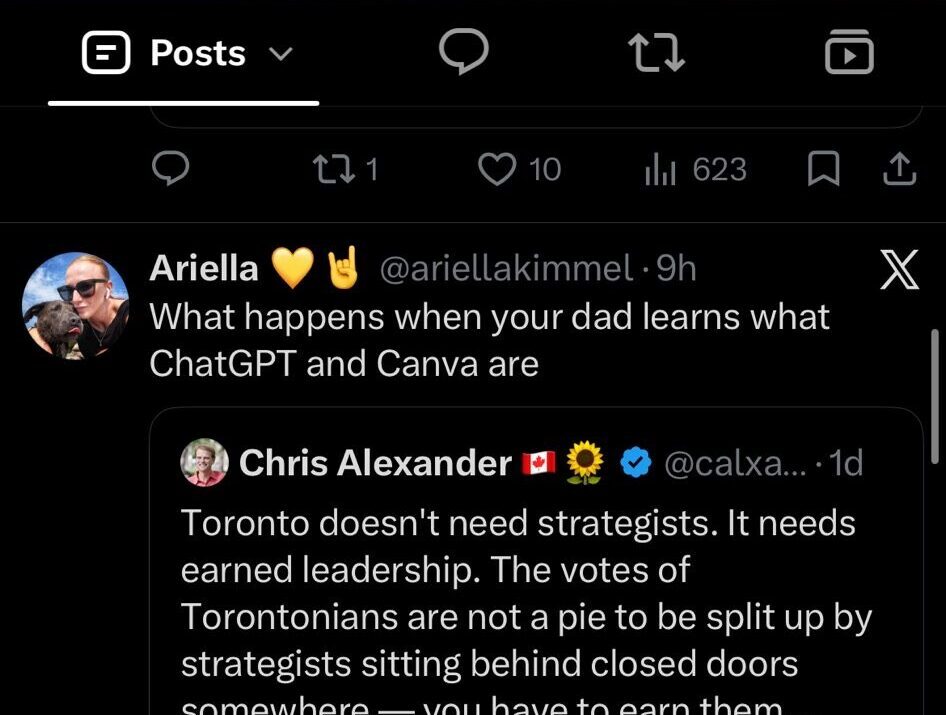
On the social media website formerly known as Twitter, Conservative operative Anthony Koch said “Man. Can’t believe I ever defended this guy. ChatGPT slop campaign.” Ariella Kimmel, who has written for conservative commentary website The Hub, echoed the sentiment, writing “What happens when your dad learns what ChatGPT and Canva are.”
The article came to my attention as I was putting the finishing touches on my latest article for The Walrus, “Chris Alexander Wants to Be Mayor of Toronto, God Help Us”, published August 20th.
My initial reaction was that there was something a bit off about Desveaux’s article, namely because it included quotes attributed to Chris Alexander that I couldn’t find published anywhere else, nor from his scrum with reporters at Toronto City Hall when he registered his candidacy. I reached out to Clinton in addition to Chris Alexander’s campaign for an explanation.
While Chris Alexander’s campaign team did not reply to my specific questions—including whether they had hired Clinton Desveaux to write the article they were now quoting from, and whether said article was developed using AI—they did complain about my questions to staff at The Walrus, including the fact checker.
Clinton, by contrast, did respond to my questions, and was a good sport about it.
“It’s not AI, it’s my column,” said Desveaux, in an interview with Noakesworthy. “I’ve written columns for 30 years.”
He explained that he wrote the article himself and that he used “Microsoft Word for spell check and grammar composition and sentence structure.” He also said that he was not paid to write the article in question, and “I don’t work for Chris’s campaign or any third parties directly or indirectly connected to Alexander or anyone connected to the mayor’s race.”
What then of the quotes attributed to Chris Alexander?
Desveaux explained that the quotes are a “mix of my own discussions with him and that which has appeared in other media sources,” though he did not specify which other media sources he was referring to. Later in the conversation Desveaux stated that the quotes he included in the article are “all from Chris”.
Desveaux added that he has known Chris Alexander “on a casual basis since the federal conservative party leadership race of 2017, approximately nine years ago. We have discussed municipal, provincial, federal, and international issues over that time.”
This was not disclosed in the Unpublished article. Nor was it disclosed by Chris Alexander or his campaign team.
“Chris is not a friend, he’s an acquaintance,” added Desveaux. “Politicians are not friends, that’s been my experience in life.”
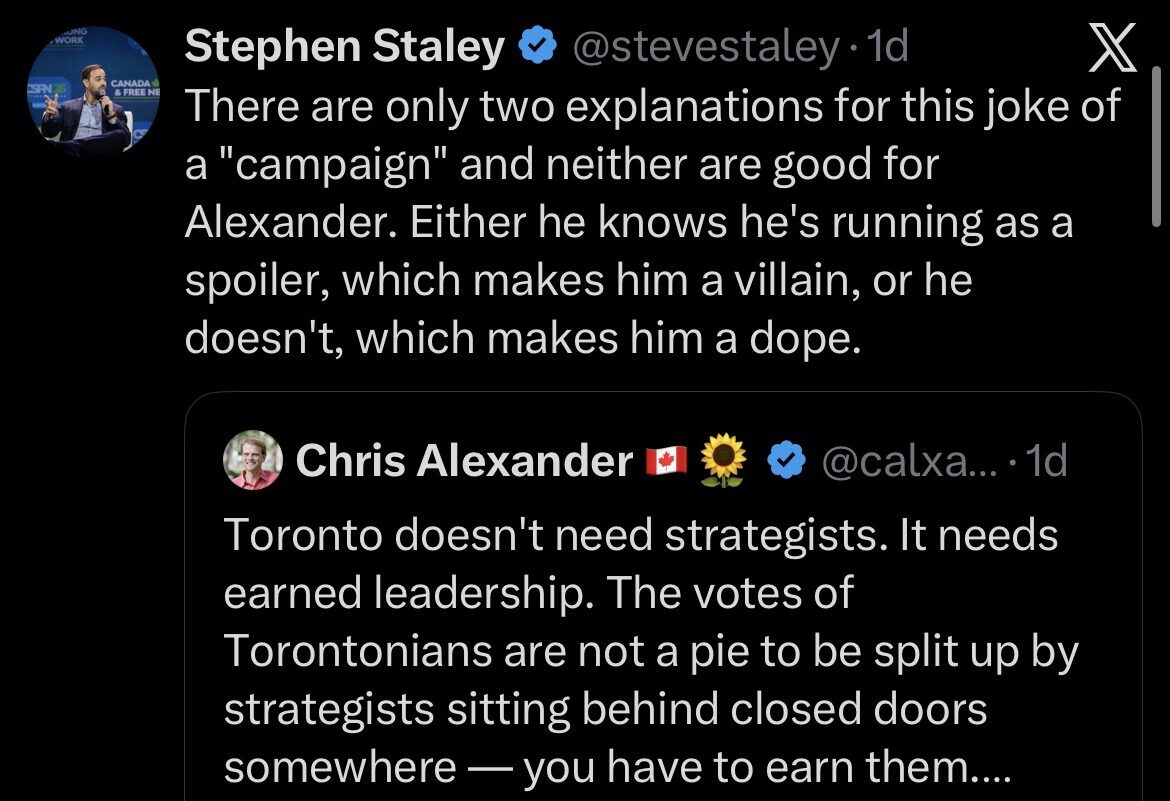
Alexander’s campaign has been a source of considerable ire for Canadian conservatives, who believe he is splitting the rightwing vote in the race to dethrone incumbent Toronto Mayor Olivia Chow. Alexander’s social media campaign, which included numerous posts quoting from Desveaux’s article, drew a sharp and negative reaction from a host of conservative supporters. Former Toronto political reporter Sue-Ann Levy responded “You have one week to show us your ‘plan’ or drop the hell out.” Stephen Staley, former executive assistant to Canadian prime minister Stephen Harper, wrote “There are only two explanations for this joke of a ‘campaign’ and neither are good for Alexander. Either he knows he’s running as a spoiler, which makes him a villain, or he doesn’t, which makes him a dope.”
Alexander was Stephen Harper’s last immigration minister and has long been viewed as a loyal Tory foot soldier, particularly in the 2015 federal election campaign, where he routinely pushed some of the Conservatives’ more radical—and unpopular—policies and programs. The total lack of major Conservative endorsements for the formerly high profile cabinet minister has not gone unnoticed.
Where Alexander does have considerable support is Canada’s ultranationalist Ukrainian community, an alliance that’s got him in trouble many times in the past, and which may be responsible for Alexander’s accusation veteran Ottawa Citizen defence reporter David Pugliese was a Russian spy. Alexander made the accusation under the protection of parliamentary privilege, has not repeated the claim since (likely because he could be sued for defamation), and appears to have based his claim entirely on elaborate forgeries that may have been provided to him through back channels with connections to Ukraine’s intelligence service. Pugliese is well known for critical reporting regarding Canada’s military assistance to Ukraine.
While Chris Alexander’s steadfast support for Ukraine in its existential fight against Vladimir Putin’s illegal and unjust war ought to be uncontroversial, his involvement with the Ukrainian far right is a considerable problem.
Alexander has consistently found himself supporting the interests of Ukrainian ultranationalists, including organizations that continue to defend and promote the Ukrainian fascists that partnered with Nazi Germany during the Second World War. As immigration minister in 2014, Alexander attended a Ukrainian fundraising effort in the company of representatives of the neo-Nazi group Right Sector Canada. Asked about it by a Radio-Canada reporter, Alexander responded by asking the journalist if they were inquiring about Canadian companies doing business with Russia. Though it’s important to note Olivia Chow attended the same event, she wasn’t a cabinet minister representing the federal government at the time (nor does she have Alexander’s professional experience working in Canada’s Moscow embassy for a decade).
More importantly, Chris Alexander has been linked to the Ukrainian ultranationalist community in several other instances, including speaking at a Ukrainian cultural centre in Toronto affiliated with the Banderite movement. The Banderites are followers of Stepan Bandera, a Ukrainian ultranationalist who led a radical faction of the Organization of Ukrainian Nationalists (OUN). The OUN was allied to Nazi Germany during the war, and eagerly participated in the Holocaust.
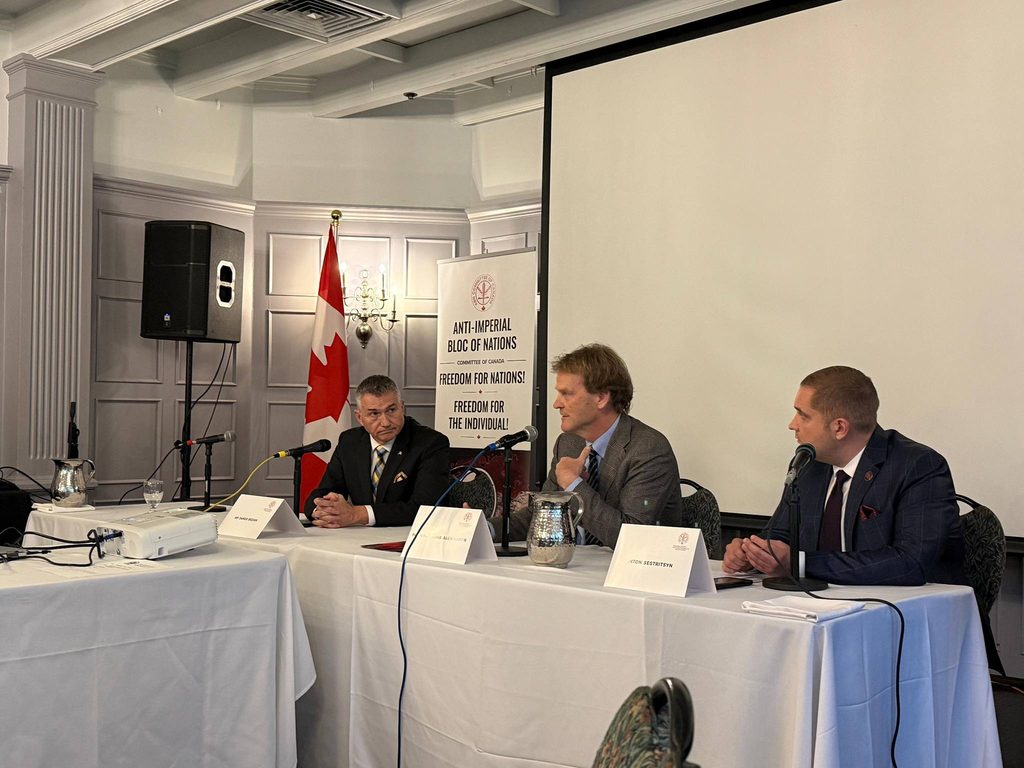
It appears that Alexander has maintained these affiliations, having recently been photographed (along with Conservative MP James Bezan—see photo at top of page), participating in a panel discussion hosted by the Anti-Imperial Block of Nations (ABN). The ABN was formerly known as the the Anti-Bolshevik Block of Nations, itself a creation of the Bandera faction of the OUN. The ABN’s longtime leader, Yaroslav Stetsko, collaborated with the Nazis during the war and held virulently antisemitic views.
It is entirely possible that Chris Alexander may not be aware of this history, though that in and of itself leads to questions about Alexander’s command of the history and geopolitics of Eastern Europe and the former Soviet Union, an area where he professes to have considerable experience. Alexander has highlighted that experience in his mayoral campaign.
He and his campaign were sent several emails with direct and specific questions on this subject; neither replied.
On August 21st, 2026, Alexander commented on growing antisemitism concerns in the city of Toronto, saying “For too long, this crisis has been left to escalate. We need new leadership to end it for good.”